When choosing a wound dressing, attention often goes to visible features: absorbency, thickness, softness, or appearance. But behind these characteristics is a more fundamental factor—the material.
A wound dressing is not simply a piece of absorbent material placed over a wound. Different materials interact with wound fluid, air, pressure, and the wound surface in different ways. Even small changes in material selection can influence how a dressing absorbs exudate, retains fluid, conforms to the wound, and behaves during dressing changes.
So, what actually changes when the material changes?
The Material Determines What Happens After Contact With Exudate
The most important difference between dressing materials may not be how they look before use, but how they behave after contacting wound fluid.
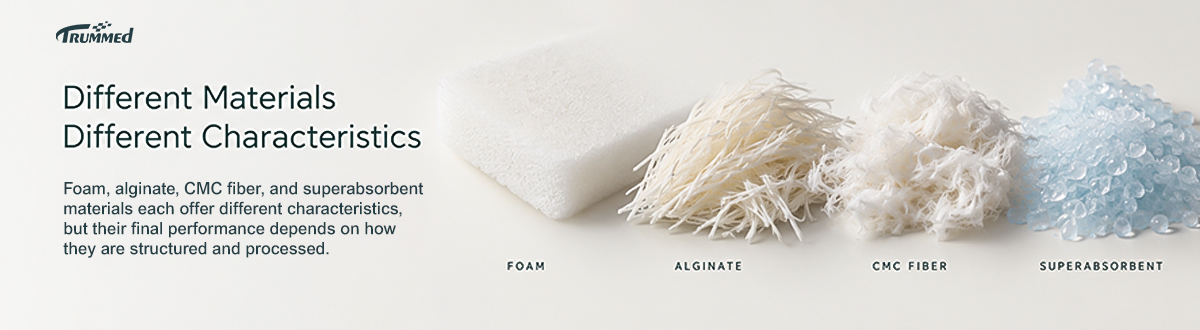
Foam materials use their porous structure to take up and retain fluid. Their performance can be influenced by pore size, density, thickness, and the structure of the absorbent layer.
Alginate and CMC fibers work through a different mechanism. When exposed to exudate, the fibers absorb fluid and can form a soft gel. This transformation allows the dressing to adapt to irregular wound surfaces while continuing to manage fluid.
Superabsorbent materials take another approach. Their structure is designed to capture and retain a large amount of liquid, helping manage wounds where fluid handling is a major requirement.
This means that absorption is not a single function. The speed of absorption, amount absorbed, ability to retain fluid, and behavior after absorption can all vary according to the material.
A Softer Material Does Not Always Mean a More Comfortable Dressing
Softness is often associated with comfort, but material selection involves more than simply choosing the softest option.
A dressing needs to balance softness with structural stability, conformability, and handling properties. If a material becomes too fragile after absorbing fluid, for example, it may be difficult to remove or handle.
Likewise, a highly flexible material may conform well to the body but may require a different backing layer or structural design to maintain its integrity during wear.
This is why material properties should be considered as a combination rather than in isolation.
The Same Material Can Still Produce Different Results
Material selection is only the beginning.
Two dressings can use the same basic material but have noticeably different performance because of differences in:
· Material thickness
· Fiber or pore structure
· Absorbent layer density
· Backing materials
· Layer configuration
· Adhesive or contact layer
· Manufacturing process
For example, changing the thickness of an absorbent layer can affect both fluid capacity and flexibility. Adjusting fiber density can influence fluid uptake and gel formation. A different backing film can change how moisture is managed within the dressing.
In other words:
Material + Structure + Processing = Final Dressing Performance
The material provides the foundation, but the finished product is shaped by how that material is engineered.
Why Material Selection Should Start With the Intended Function
Instead of asking, “Which material is the best?”, product developers should ask:
What does the dressing need to do?
A dressing intended to provide cushioning and absorb moderate exudate may require a different material structure from one designed for heavy fluid management.
A dressing intended to conform to an irregular wound may require different characteristics from one designed for easy handling and extended wear.
The same principle applies to different anatomical locations. A dressing used on a joint, for example, may need a different balance of flexibility, adhesion, and structural strength than one used on a relatively flat area.
The goal is therefore not to find one universally superior material, but to match material properties with the intended application.
Material Innovation Is About More Than New Materials
In wound care, innovation does not always mean creating an entirely new material.
Sometimes, meaningful improvements come from using an existing material in a new structure, combining multiple layers, adjusting material thickness, or refining the manufacturing process.
A familiar material can perform very differently when its structure is redesigned.
This is particularly important for manufacturers developing customized wound dressing products. A customer's requirements may involve a specific balance of absorbency, flexibility, thickness, moisture management, or wear characteristics. Meeting those requirements may require more than simply selecting a material from a catalog.
It requires understanding how the material behaves inside the finished product.
From Material Selection to Product Development
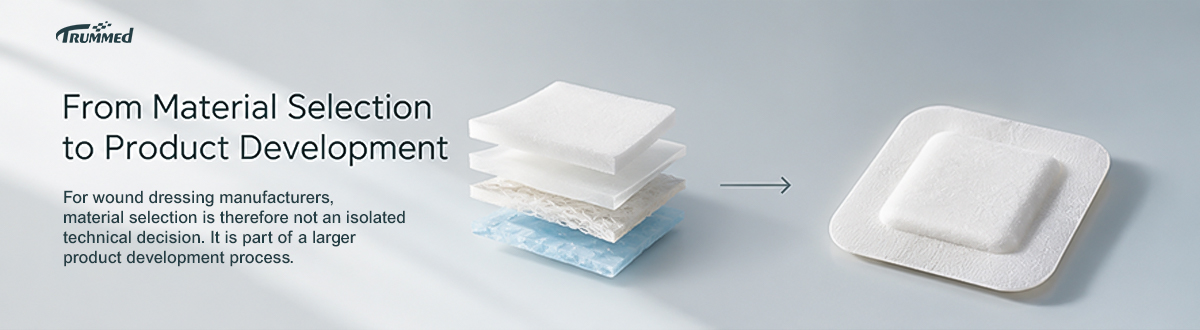
For wound dressing manufacturers, material selection is therefore not an isolated technical decision. It is part of a larger product development process.
Foam, alginate, CMC fiber, and superabsorbent materials each offer different characteristics, but their final performance depends on how they are structured and processed.
At Trummed Medical, wound dressing development can be approached from both the material and product-design perspective, with options including foam dressings, CMC fiber dressings, alginate dressings, and superabsorbent dressings.
The right material is not simply the one with the highest specification. It is the one that can be engineered into a dressing that meets the intended application.