For decades, wound care followed a simple rule: keep it clean and dry.
But modern clinical research has completely changed that perspective.
Today, moist wound healing is widely recognized as the gold standard in advanced wound care. Not because moisture alone heals wounds—but because a controlled moist environment enables the body to repair itself faster, safer, and with fewer complications.
The real question is no longer “Should wounds be moist?”
It’s “How do we control moisture effectively?”
The Problem with Dry Wound Healing
Traditional dry healing often leads to scab formation. While scabs may seem protective, they actually create barriers to efficient healing:
· Inhibit epithelial cell migration
· Increase dressing adherence and removal trauma
· Delay healing time
· Raise the risk of visible scarring
In simple terms:
A dry wound is not necessarily a healing wound—it may be a slower one.
Why Moist Wound Healing Works
Scientific studies have shown that wounds heal more efficiently in a moist environment. Here’s why:
1. Faster Cell Migration
Skin cells (keratinocytes) move more freely across a moist surface, accelerating wound closure.
2. Preservation of Growth Factors
Moisture helps retain essential proteins and enzymes that drive tissue regeneration.
3. Autolytic Debridement
The body naturally breaks down dead tissue in a hydrated environment—reducing the need for aggressive intervention.
4. Reduced Pain
Moisture protects exposed nerve endings, making the healing process more comfortable.
5. Lower Infection Risk
A properly managed moist environment supports the skin barrier and immune response.
Key takeaway:
Wounds heal best not when they are dry—but when they are optimally hydrated.
The Real Challenge: Moisture Control
Here’s where things get more complex.
Moist wound healing is not about making a wound “wet.”
It’s about maintaining balance.
What can go wrong?
· Too dry → delayed healing, scab formation
· Too wet → skin maceration, infection risk
The deciding factor is exudate management.
And this is exactly where many traditional dressings fall short.
CMC (Carboxymethyl Cellulose) gelling fiber dressings are designed to solve one critical problem:
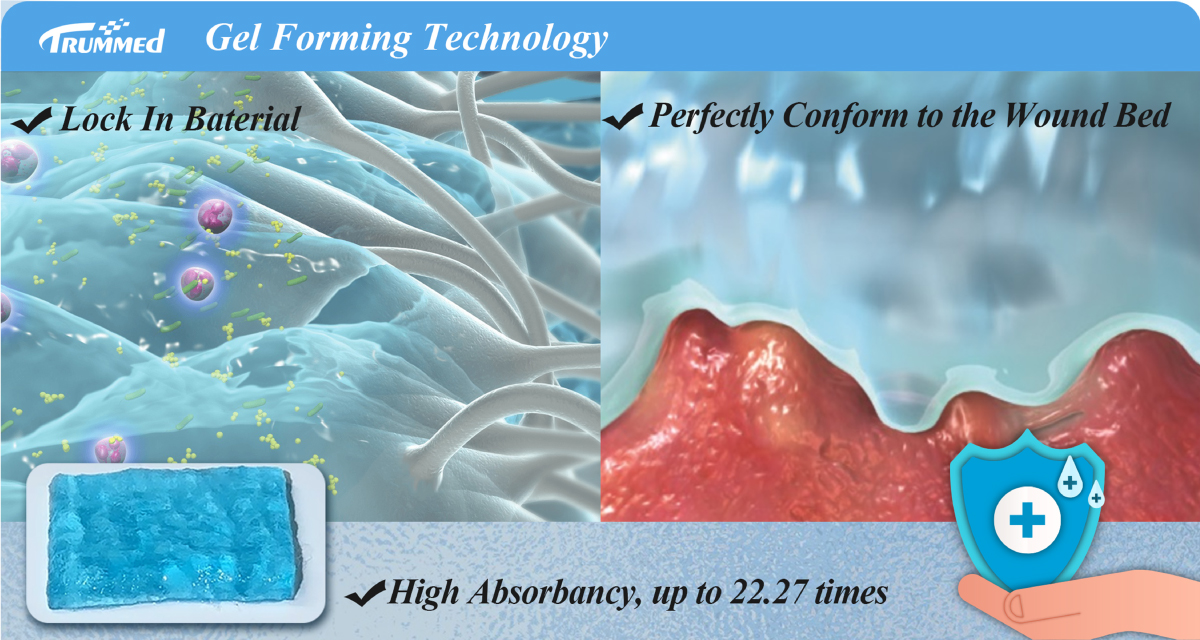
How to maintain the ideal moisture level—automatically.
1. Absorb & Lock
Transforms exudate into gel and locks it in—reducing leakage and protecting surrounding skin.
2. Balanced Moisture
Maintains an optimal moist environment—no dryness, no maceration.
3. Conforms to the Wound
Adapts to the wound shape, improving contact and minimizing dead space.
4. Atraumatic Removal
Non-adherent to new tissue—less pain, less damage during dressing changes.
Conclusion
Moist wound healing has become the cornerstone of modern care because it works with the body—not against it.
When moisture control determines healing outcomes, not all dressings perform equally—gelling fiber makes the difference.