
In modern wound care, CMC fiber dressings (gelling fiber), alginate dressings, and foam dressings are among the most commonly used options for managing exudate. While they may appear similar at first glance, their materials, mechanisms, and ideal use cases are quite different. The key is not which one is “better,” but which one is most appropriate for the wound condition.
Understanding the Core Differences
These dressings can be broadly divided into two functional groups.
CMC and alginate belong to gelling dressings, meaning they interact with wound fluid to form a gel. Foam dressings, on the other hand, are absorptive dressings designed to take in fluid while providing cushioning and protection.
Alginate, derived from seaweed, forms a gel through ion exchange when it comes into contact with exudate. CMC fiber dressings work in a similar way but tend to form a more cohesive and stable gel structure, helping to retain fluid within the dressing. Foam dressings rely on a porous structure to absorb and hold fluid, without forming a gel.
In simple terms:
· Alginate / CMC = fluid management through gel formation
· Foam = absorption with physical protection
Absorption Capacity: Which Handles Heavy Exudate Better?
All three dressings can absorb exudate, but their performance differs depending on the level of fluid.
Alginate dressings are known for their high absorption capacity and are often used for heavily exuding wounds or wounds with minor bleeding. Foam dressings are suitable for moderate to high exudate, but they mainly absorb and distribute fluid rather than locking it in place.
CMC fiber dressings also offer strong absorption, but their key advantage lies in how they manage the fluid after absorption. By forming a cohesive gel, they help keep exudate contained, reducing the risk of leakage or spread to surrounding skin.
As a result:
· Alginate: very high absorption, but less structural stability
· Foam: good absorption with cushioning, limited fluid control
· CMC: balanced absorption with stronger fluid retention
Impact on the Wound Environment
Effective healing depends on maintaining a moist but controlled environment.
Both alginate and CMC support moist wound healing through gel formation. However, alginate can sometimes lose structural integrity when saturated and may require a secondary dressing to hold it in place. CMC fiber dressings typically maintain better integrity, allowing for more stable contact with the wound and easier removal in one piece.
Foam dressings help maintain moisture to a certain extent, but in wounds with heavy exudate, fluid may spread laterally, increasing the risk of maceration around the wound edges.
Overall:
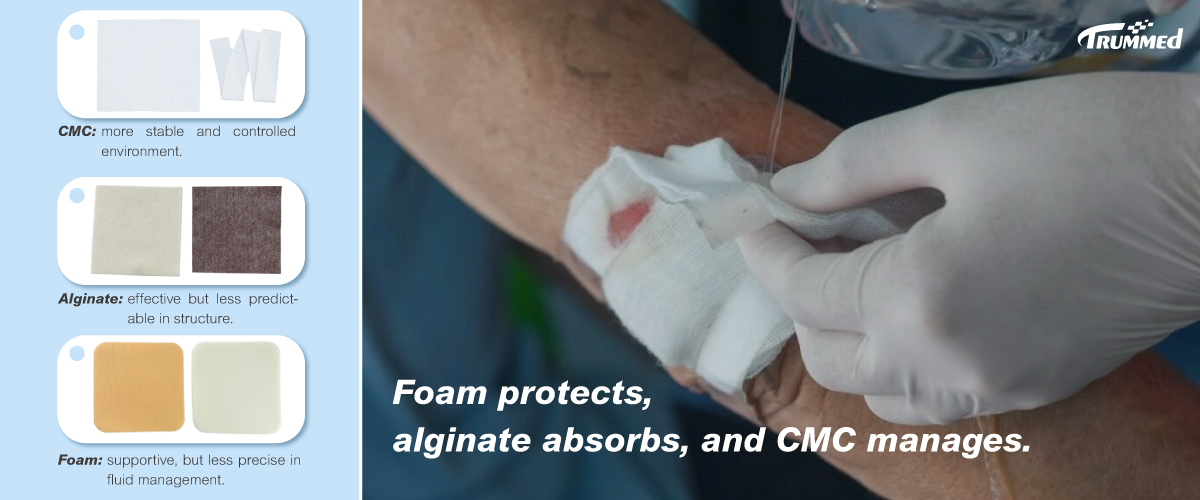
· CMC: more stable and controlled environment
· Alginate: effective but less predictable in structure
· Foam: supportive, but less precise in fluid management
Dressing Changes and Patient Comfort
Frequent or disruptive dressing changes can slow healing by damaging newly formed tissue.
Both alginate and CMC form gels that reduce adhesion to the wound bed, making removal generally more comfortable. However, alginate may occasionally leave residue in the wound, especially in deeper or irregular areas.
CMC fiber dressings are designed to maintain integrity during use, which often allows for cleaner, one-piece removal and less disturbance to the wound.
Foam dressings are non-adherent but may need to be changed more frequently in high-exudate situations, which can interrupt the healing process.
From a “low-disruption” perspective:
CMC > Alginate > Foam
When to Use Each Dressing
Choosing the right dressing depends largely on exudate level and wound type.
· Heavily exuding wounds or cavity wounds
→ CMC or alginate
· Wounds with minor bleeding or very high exudate in early stages
→ Alginate
· Moderate exudate with a need for cushioning (e.g., pressure areas)
→ Foam
· Situations requiring stable fluid control and fewer dressing changes
→ CMC
Conclusion: It’s About Matching the Need
The differences between CMC, alginate, and foam reflect an evolution in wound care—from simple coverage to more advanced fluid management.
· Foam focuses on protection and absorption
· Alginate focuses on high absorption
· CMC focuses on controlled fluid management and stability
The more complex the exudate, the more important it becomes to manage it effectively—not just absorb it.
In One Line
Foam protects, alginate absorbs, and CMC manages.
Understanding this makes choosing the right dressing much more straightforward.